Juliusz Fedyk
Co-creator of the Skillforests method. As a development lead, used its early form to grow a team of 5 into 17 specialists — by naming what the work actually took and training toward it, bottom-up.
Team Biome Assessment · free · 60 minutes
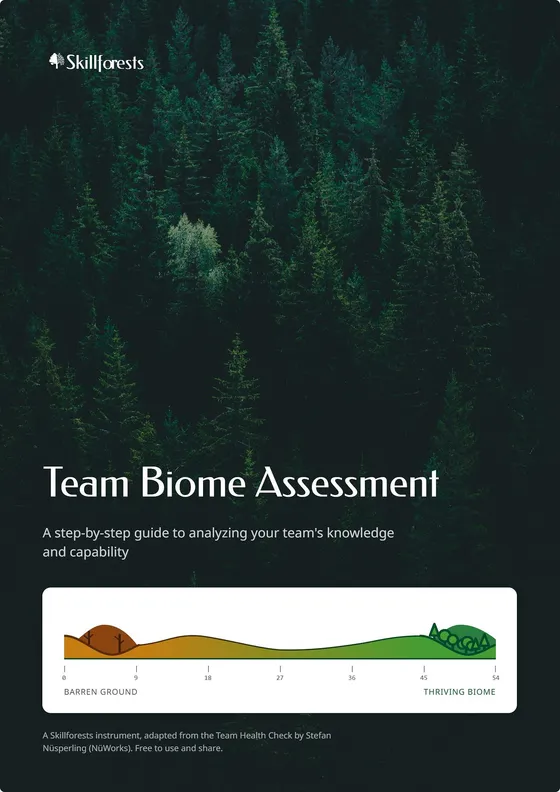
The Team Biome Assessment is a free 60-minute session for team leads and managers. We look at how knowledge travels through your team, how visible skills are, and how people grow. We analyse what dimensions your team excels at, what it can grow out of, and what requires leadership input. You get a short written report within a few days.
The Biome Scale


Inside your team
Some problems live inside your team: skills that exist in exactly one head, juniors who can’t yet work alone, knowledge that never moves between people. These your team can grow out of — with a plan and a path.
Your team can grow out of these.
Outside your team
Some problems live outside: shifting priorities, missing headcount, decisions made above you. No amount of training fixes these — but naming them clearly, in writing, changes the conversation you can have with your own leadership.
These need naming, in writing, upward.
One hour. Every issue in one table — inside or outside, working or not. You leave knowing which is which, and what to do about each.
Walk the steps — the pages on the right fill in as they do.
Scorecards
complete · scores 0–9Team — Platform, 9 people, 2 juniors
Pressing — Q3 migration, one senior leaving
One page per dimension in the real instrument — questions, your answers, the score.
Radar
one shapeEvery dimension score, plotted on one page.
Biome health card
inside · outsidePlacement on the Biome Scale
The Team Biome Assessment looks at how knowledge and skill actually move through your team: six dimensions, each with questions a manager can answer from a normal week. Mapping the skills themselves — who has what, and how deep — is what a SkillForest workshop does.
Which skills does the work demand that nobody on the team has?
Who decides who works on what — and when deadlines are set, does anyone ask what the team can actually deliver?
What kinds of knowledge does the team run on — and which kind lives in exactly one head?
Does knowledge move between people and onto paper — or does work wait when someone's away?
How are skills tracked today — and does the tracking feed anyone's career?
How do juniors become seniors here — onboarding, training, promotion, and who's next in line?
Short, written, yours within a few days:
Every line in the report traces back to something you said in the hour — nothing gets invented after the call. And the blockers page tends to travel: it’s written to be forwarded upward, unedited.
Team Biome Report
Platform team · page 1Radar snapshot
Knowledge moves in conversation, not on paper. Written flow is the shortest way forward.
Biome Scale
Growth areas (inside)
Blockers (outside)
Free, and nothing to prepare. Online anywhere, or in person around Tokyo. One hour with your team lead, and a written report within a few days.
Thanks — we’ll reach out to schedule within a few days.
Online or in-person (Tokyo area), your choice.
The Team Biome Assessment Guide is the complete instrument, step by step: the six dimensions, every question, the scorecards, the radar, and the Biome health card — everything you need to assess your own team in about an hour. It’s part of the Skillforests documentation, free for subscribers.
Get the assessment guideThe free session is us running the assessment with you. If you’d rather run it yourself first, we’re happy to take a look at your results afterwards.
Nothing. The assessment is free for businesses and teams of any size.
Because we'd rather give team leads the tools and help them see for themselves what skill management can do for their team — no pitch lands as well as that. There's no obligation and no pitch inside the hour.
The team lead or manager — the person who sees the team daily. Just you is enough; it's not a team workshop.
Yes. What's discussed and what goes in the report stays between us and you.
Either. Online anywhere; in-person in the Tokyo area.
Nothing. If you've run the assessment guide yourself, bring your summary sheet — we'll start from your radar.
Juliusz Fedyk
Co-creator of the Skillforests method. As a development lead, used its early form to grow a team of 5 into 17 specialists — by naming what the work actually took and training toward it, bottom-up.
Stefan Nüsperling
Founder of NüWorks, licensed Management 3.0 facilitator, and specialist in growing intercultural, self-organizing teams in Japan. Brings the facilitation craft that turns a room of practitioners into a forest.